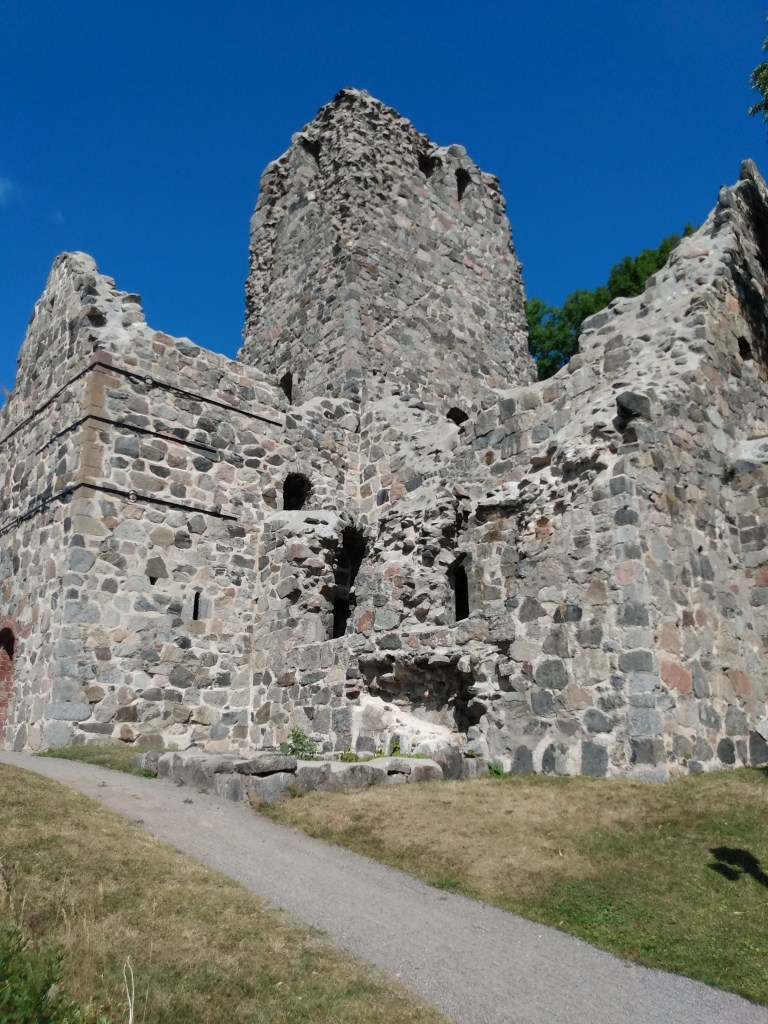
In the churchyard of the Church of Mary (Mariakyrkan) in Sigtuna, an echo from the past can be found. It’s a reminder that Sigtuna has a very long history. This echo is by no means ethereal but the very physical remains of the Church of St. Olav.
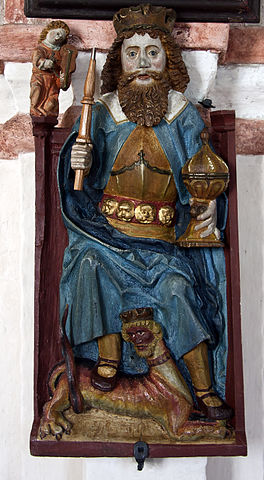
Olof, in this context, is “of course” Olav Haraldsson, one-time king of Norway and after his death, the first saint of the Nordic countries. Olav was born in Norway in 995, the son of the local king Harald Grenske and Åsta Gudbrandsdatter, and married to Astrid Olofsdotter of Sweden, daughter of the Swedish king Olof Skötkonung (himself the son of the founder of Sigtuna, Erik Segersäll) and his mistress Edla.
Olof was a descendant of Harald Fair Hair and half-brother of Harald Hardrada.
In his younger years, Olav Haraldsson was a successful Viking, raiding around lake Mälaren in Sweden, the Baltic Sea, and along the coast of Denmark. He was involved in power struggles for the throne in England and allegedly destroyed London Bridge. Eventually, Olav turned his ships towards Normandie, where he accepted the Christian faith.
Returning to Norway in 1015, Olav is said to have taken over power from the Earls Håkon Eriksson and Sven Håkonsson. It should be mentioned that it was not until early medieval sagas that Sven Håkonsson is named as a co-ruler. In contemporary sources, he isn’t mentioned.
A year after his arrival Olav Haraldsson founded the town Borg – from the 13th century known as Sarpsborg – which became the capital of Norway. Not just a king but a Christian king, Olav set about converting the Norwegians through brutal methods. You didn’t have to be a benign person to reach the status of sainthood after your death; spreading the word of Christ through violence and cruelty could still get you there.
According to Olav’s Saga by Snorre Sturlasson, Olav became a hated man and was banished from Norway in 1028 due to said cruelty. He went into exile in Novgorod where he stayed for a year, after which he returned to Norway, bringing with him forces from Sweden.
Allegedly Olav died during the battle of Stiklestad in 1030. The battle stood between Olof’s forces and farmers from the Norwegian region of Tröndelag. “Allegedly”, because despite being Norway’s most famous battle, there is no mention of it in contemporary sources or any historical chronicles before the canonisation of Olav by Pope Alexander III in 1164.
Instead, it’s believed Olav was killed in an ambush, a less glorious death than on the battlefield. Snorre Sturlasson – writing 200 years later – means that the battle did take place and that Olav was surrounded and died from three stab wounds.
Soon after Olav’s death, miracles started happening; a visit to his grave would heal the sick and give eyesight and hearing back to the blind and the deaf. Allegedly his hair and nails also continued to grow, and pilgrims flocked to his relics in the newly built cathedral Nidarosdomen in Trondheim (at the time called Nidaros).
The cult of Olav spread, not only to Sweden but to Russia and what is now the Baltic states. At one point, churches were built in his honour in both Jerusalem and Istanbul.
In Sweden, the cult of Olav cult was strong, and now we return to St Olof’s Church in Sigtuna, one of the oldest churches built there. The church is believed to have been built during the early 12th century, but its history goes further back than that. An archaeological excavation in 2000 revealed older walls below the ruins, indicating that there was already a church here in the 11th century.
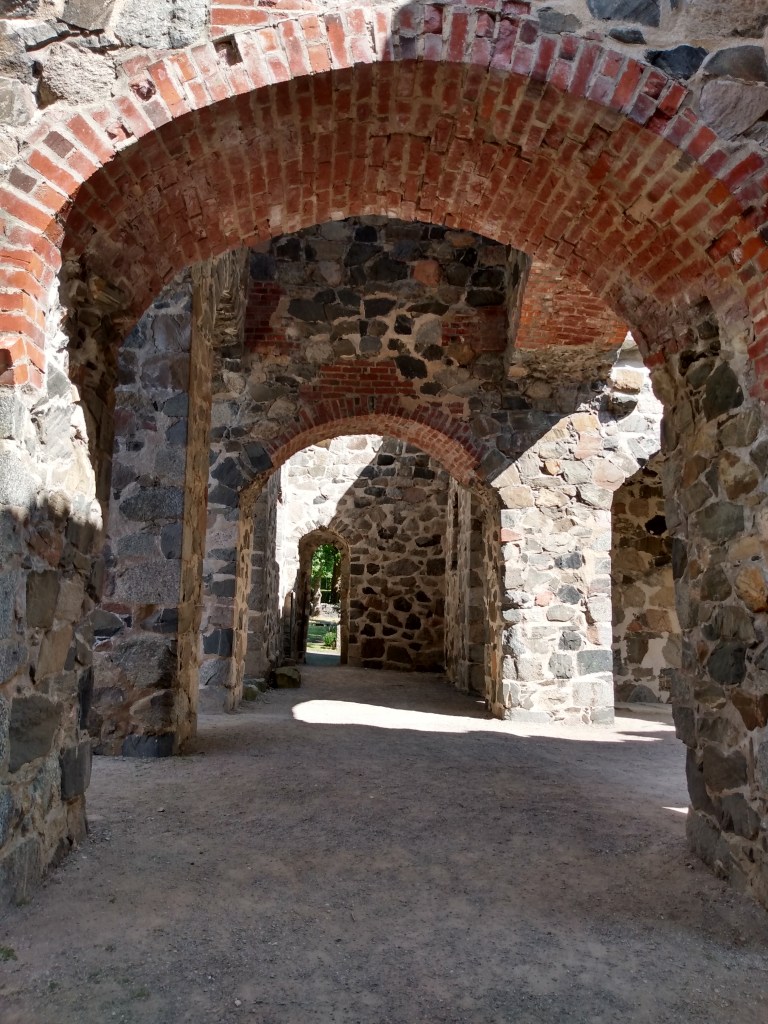
Those walls are no longer visible as the shafts have been filled up again. What are visible the remains of a small stone house, believed to have been built around a sacred well connected to the Olof cult.
Those walls are no longer visible as the shafts have been filled up again. What are visible the remains of a small stone house, believed to have been built around a sacred well connected to the Olof cult.
This goes back to the legend, saying that Olof created springs by hitting the ground with his staff. The legend also tells that Olof passed through Sigtuna when returning to Norway from his exile in Russia. During this period, Sigtuna was the seat of the Swedish king, who in 1030 was Anund Jacob, brother of Olof’s wife, Astrid. It may have been here he recruited Swedish men to join his forces.
During a time, Sigtuna was one of several sees, and it’s possible St Olof’s church from the beginning was meant to be a cathedral. This theory is based on outer walls being found under a nearby street, but for whatever reason, the cathedral was never built.
Sources.
Sankt Olof: vikingen som vandrade över Kölen – Erling Matz
Helgonet i Nidaros: Olavskult och kristnande i Norden – Lars Rumar/Riksarkivet
Sigtuna:
Stockholms läns museum
Riksarkivet
Images:
St Olav – David Castor
Church of St Olav, Sigtuna – blog owner

 Scandinavian History
Lämna en kommentar