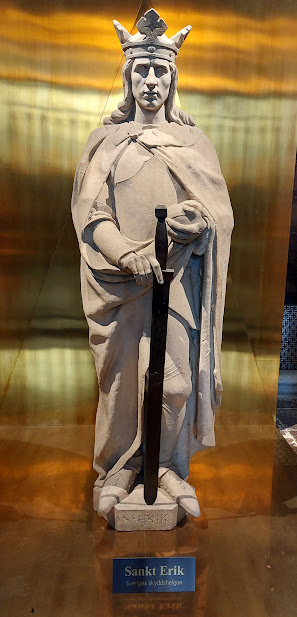
Sweden has a national saint who is not really a saint. This because the Pope did not want to canonize him. Why is a little unclear, but a letter somewhere in the now thousand-year-old records mentioning a king who fought, drank, and in the end was murdered, and therefore did not deserve this exaltation.
Whether this concerns Erik Jedvardsson – Erik the Holy – is unclear. The Swedish Middle Ages, especially the early Middle Ages, had no shortage of violent kings, who drank and, in the end, were murdered by their opponents.
Erik Jedvardsson was born sometime between 1120 and 1125, the son of the magnate Jedvard – who is sometimes assumed to be an Englishman on uncertain grounds, mainly because how rare the name was in 12th-century Sweden – and his wife Cecilia.
It is difficult to say anything about Erik with certainty, as there is a complete lack of sources about his life that are contemporary with him.
We know, however, that Erik was married to Kristina Björnsdotter, daughter of the Danish prince Björn Haraldsson Ironside and the Swedish princess Katarina Ingesdotter, something that made Kristina a granddaughter of King Inge the Elder.
Together Erik and Kristina had four children: Knut Eriksson, Filip Eriksson, Katarina Eriksdotter and Margareta Eriksdotter.
According to a Danish chronicle from 1158, Erik became king of the western Geats in 1156. According to a letter written during the reign of his son Knut, he was also king of the Svealand region.
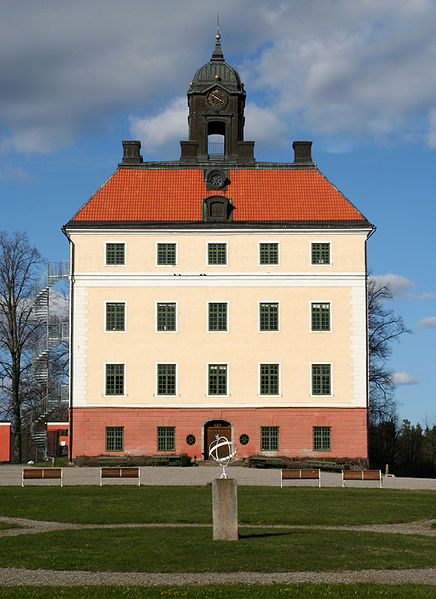
He owned Ängsö castle in Västmanland, which still stands where it stands today.
As king, he succeeded Sverker the Elder, who allegedly was murdered by the pretender to the Danish throne, Magnus Henriksson, on December 25, 1156.
According to the Erik legend, King Erik is said to have led a crusade against Finland in the 1150s. This started the colonization of the neighboring country to the east. However, the legend of Erik was written down just over 100 years later, and cannot be taken as absolute fact, not least since it, as a hagiographical text, aims to glorify Erik.
As it happened, Magnus Henriksson also murdered King Erik.
This must have happened on May 18, 1160, in connection with Erik being at a fair in Östra Aros, now Uppsala. The church was surrounded by men led by Magnus Henriksson. Erik, who chose to remain in church and hear the mass to the end despite his men asking him to flee to safety, was cut down as he left the church.
He is said to have been stabbed in the leg so that he could not fight or flee, and then decapitated while lying on the ground.
Where he died, a spring is said to have sprung up, at which miracles then occurred. Thus, the saint legend was born, and Sweden got a national saint Rome did not want.
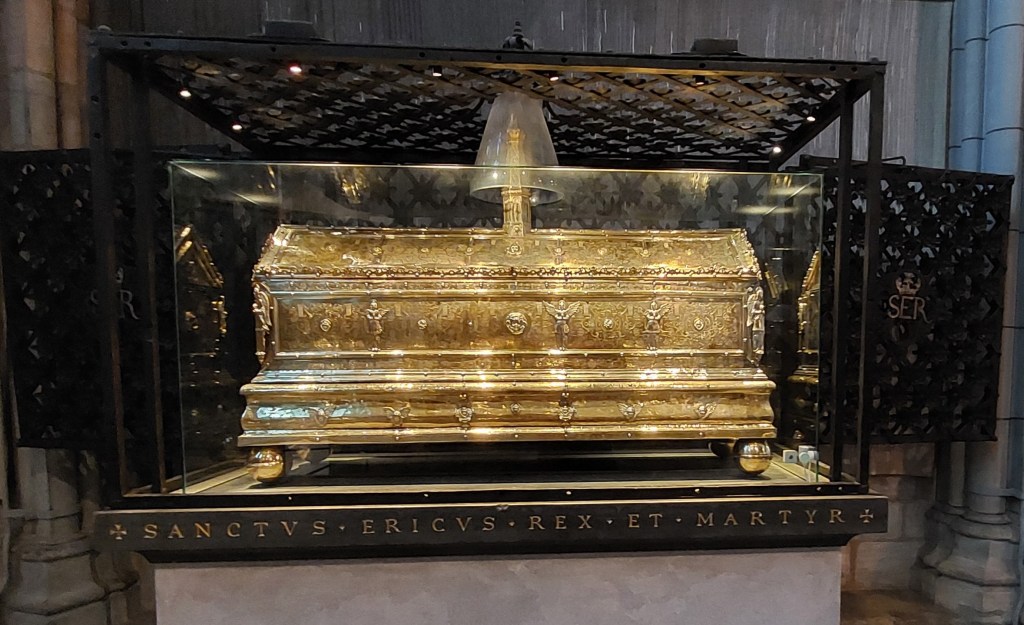
His remains ended up in a saint’s casket kept in Uppsala Cathedral since 1273.
Magnus Henriksson, who also murdered Erik’s representative Sverker the Elder, later met his death at the Battle of Örebro, where Sverker’s son Knut Sverkersson killed him in 1161, according to “Västgötska kungalängden”, royal documents connected to the region of Västergötland.
During 2014–2015 osteological examinations of the remains were performed.
With the help of carbon-14, it was possible to establish that the man in front of the scientists lived during the same period as Erik. The osteological examinations revealed he most likely died in the way contemporary sources say; from decapitation after being injuried in his legs. The location of the injuries also suggests that he was wearing chain mail.
The scientists could establish that the man lying in the casket had been around 35 years old when he died, that he had been of strong build, that he had lived an active and healthy life and was 171 centimetres tall. The examination also showed that he ate a lot of fish, which is in line with the fact that he must have been a devout Catholic. Along with the remains, there was also a royal crown, the oldest in Sweden.
Sources:
Äldre Västgötalagen (The older Västgöta law)
Svensk Medeltid/The Swedish Middle Ages – Dick Harrison
Erikslegenden/The Erik Legend
National Archives
Images:
Ängsö Slott – Tor Svensson
Other photos – the blog owner

 Scandinavian History
Lämna en kommentar