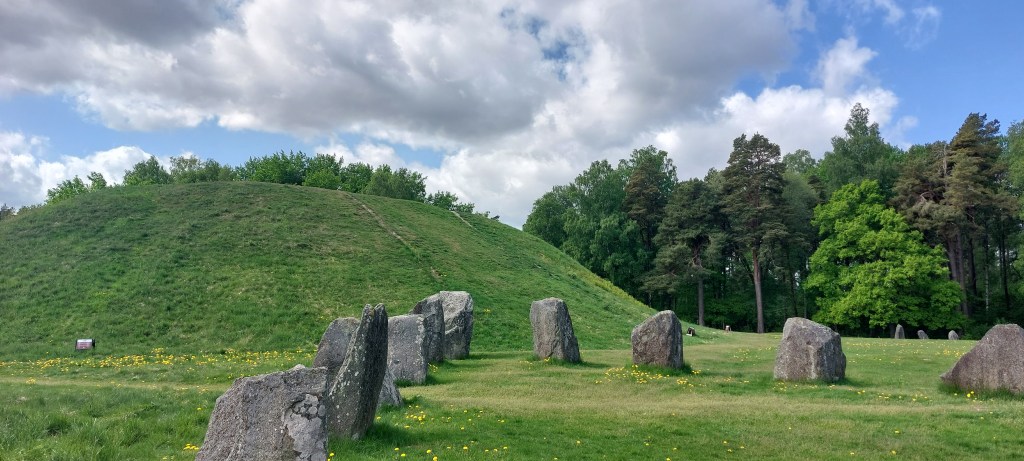
No one knows who actually lies in the mound that was already referred to as Anund’s Mound in the Middle Ages, but according to legend, it is precisely Anund who should be distinct from King Anund Jakob.
Anund is one of our fairy-tale kings, or with a more formal name, proto-kings. Those who are so far in the mists of history that we don’t know if they even existed but whose myths have survived them.
But if we go by the myths, then King Anund over Svitjod, belonging to the so-called Ynglinga family, great-great-grandson of Adils, who is mentioned, among other things, in Beowulf. Anund was also the father of Ingjald Illråde.
The area of Svitjod should not be understood as the whole of Sweden but as the region that today makes up Svealand.
Anund, or Bröt-Anund as he is also called, would have ruled during the 6th century, which could be reasonable concerning the burial mound, which could not be dated more closely than that it was built between the year 500 and the year 1050 as it was never excavated. You, therefore, do not know what is in there.
According to Snorre Sturlason’s Ynglingasaga, Anund succeeded his father, Yngvar, who is said to have been killed during a raid against the Estonians. Anund is said to have exacted revenge.
Svitjod is stated by, among others, Sturlason to have been wooded and filled with wasteland, and this is where you find the explanation for the name ”Bröt”, which in Ancient Swedish means ”road”. Anund is said to have had roads built and the wastelands constructed, which should have come in handy as Svitjod is said to have had a large population.
Anund, who is said to have had his seat in upland Tiundaland, had a royal house erected in every significant settlement where he could live when he visited his kingdom.
We don’t know when and how Anund is supposed to have died either, but there are two different versions of the latter:
According to Snorre Sturlason, he is said to have died in a landslide surrounded by mountains called Himmelshed.
According to the Historia Norwegiæ, a short royal chronicle and history of Norway, probably written by a Norwegian cleric in the 12th century, Anund is said to have been murdered by his half-brother Sigvard.
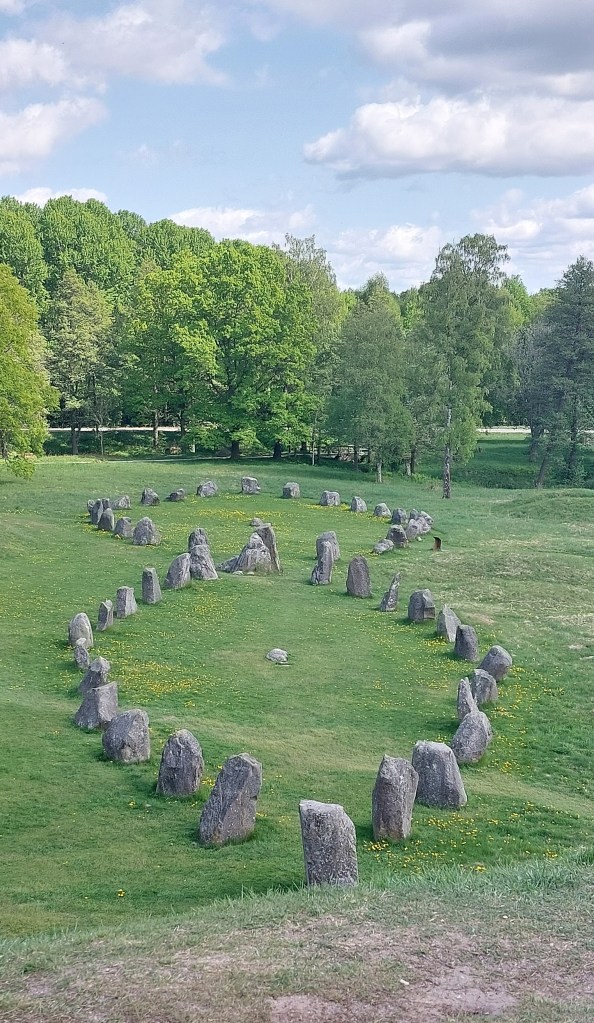
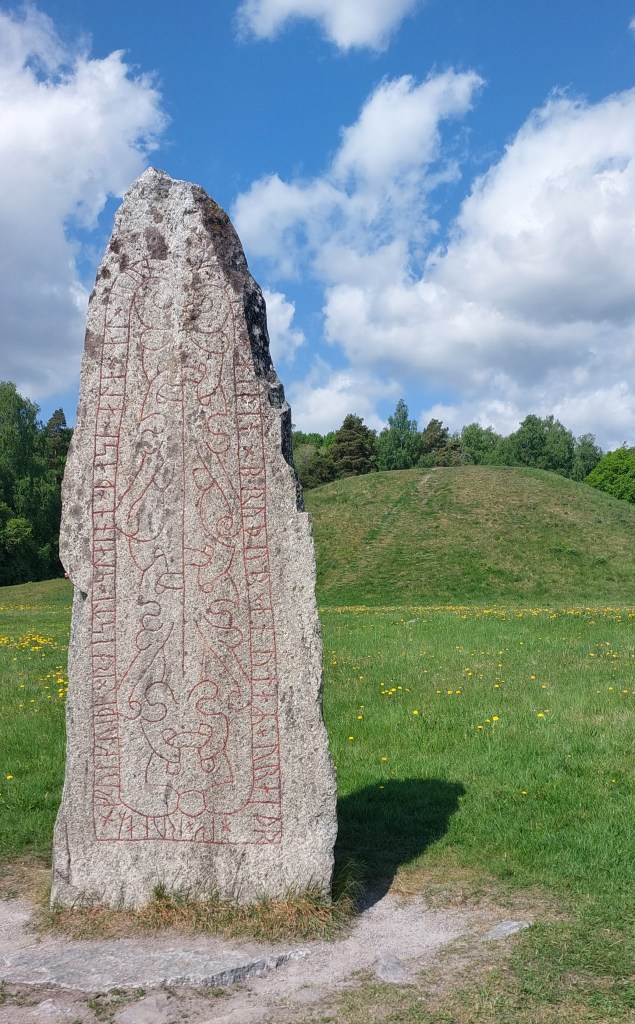
Regardless of who rests in Anundshög, it is a special place, known by its name since the Middle Ages when the area also functioned as an assembly place. With its nine meters, the burial mound is the highest in Sweden and got its flat top in 1788 when it was subjected to a looting attempt. In addition to Anundshög, there are twelve burial mounds, ten round stone burials, five ship burials, 14 raised stones and one rune stone.
Sources:
Anund (Bröt-Anund) – Svenskt Biografiskt Lexikon/Sune Lindvist
Anundshög – Riksarkivet
Photographs: the blog owner

 Scandinavian History
Lämna en kommentar