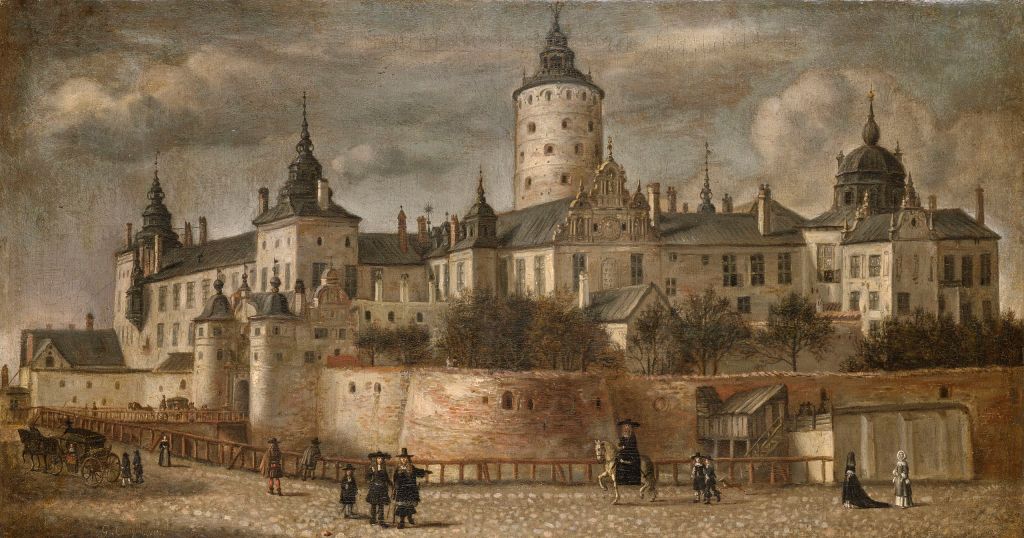
On November 6, 1540, a baby girl was born at the royal palace Tre Kronor in Stockholm.
She was named Cecilia, and if princesses at that time had surnames, it was Gustavsdotter. However, just as her father is not primarily remembered as Gustav I or Gustav Eriksson, Cecilia is also not recognised for the patronymic icon she possibly had.
Instead, she and her father have gone down in history under a name more recent than themselves: Vasa. Gustav and Cecilia Vasa.

Cecilia was Gustav’s fourth child, the third with Margareta Leijonhuvud, daughter of Erik Abrahamsson (Leijonhuvud), who, like Gustav’s own father, was executed during the Stockholm massacre in November 1520.
Margareta was probably born in 1516 or 1517 in Lillkyrka in Närke. Through her mother, she was Gustav’s cousin-granddaughter and about 20 years younger than her husband, the king.
Most of Cecilia’s siblings have made their mark on history, but with her half-brother Erik XIV and his fate, she is the most interesting of Gustav I Eriksson’s children.
Not least because today, it would be said that she gave the traditions a middle finger throughout her life.
Much was said about Gustav Eriksson during last year’s celebration of the 500th anniversary of his becoming Sweden’s king.
But most of it was about hard pinches, rebellions and state formation.
Not much was said, nor were seminars held, about the fact that there are signs in the sources that Gustav was also a caring father who worried about his children. Not least, when they fell ill, he advised their caregivers on how to treat them, made lists of foods they should be served during the illness to get better quickly, and warned them about which foods to watch out for.
There are letters about Gustav’s concerns when Cecilia, in particular, fell ill.
But Cecilia Gustavsdotter Vasa would not only make her father worried and concerned but also furious, and one occasion when this happened that went down in history was when Cecilia was 19 years old.

Of course, the plan was that she, as a princess, one day would be married off so that the marriage contracts benefited Sweden and the Swedish royal house. The same was the case for her sisters as, indeed, for any other princess.
In 1556, it was decided that Cecilia’s sister Katarina would marry the East Frisian Count Edzard.
Two years later, in 1558, he arrived in Stockholm with his entourage to finalise the marriage negotiations for the impending wedding. This process tested Gustav’s patience more than once, not least when the wedding, which was supposed to have taken place at Pentecost 1559, was postponed another few months until October 1 of the same year.
It was not only the protracted preparations for the wedding that caused the relationship between the bride’s father and the son-in-law to chafe; this continued even after the wedding vows were pronounced.
As soon as the festivities were over, Edzard announced that he and his new wife would go to Ostfriesland, something Gustav objected to because it was difficult to travel so far in the winter. However, Edzard did not budge an inch but used means of pressure: if he could not return home with his new wife, he would leave her in Stockholm and travel home alone.
Gustav, who was not a fool, realised that this would leave his daughter and himself open to gossip and malicious speculation, and he simply had to go along with it.
That conflict and the tense atmosphere had meant that Cecilia, who would dance to her own tune for the rest of her life, could operate in obscurity.
What is beyond all doubt, however, was that she and the groom’s brother Johan had opened their eyes to each other, and Cecilia now began to beg and ask to accompany the bride and groom on their journey.

At first, her father the King answered with the most definite ”no”, something Cecilia, however, was not satisfied with. After more persistent nagging and finally assurances from her siblings Katarina and Erik (later Erik XIV) that they would look after her, Gustav gave her permission to accompany her as far as Vadstena, where her brother Magnus was based at Vadstena Castle.
There would have been a festive atmosphere at Vadstena Castle – Sweden’s only Vasaborg in the true sense of the word, completed in 1545 – barely 15 years before what came to be known as the Vadstena Rumble.
On the night between December 13 and 14, Jon Andersson, sitting on guard in the castle courtyard, saw something he didn’t expect. Up the castle wall, towards the window of Cecilia’s bedroom, a man climbed on a rope ladder that was hung out the window.
The man was Johan, and if there had been any doubt as to his identity as he struggled up the wall, these were dispelled when the guards stormed into Cecilia’s room.
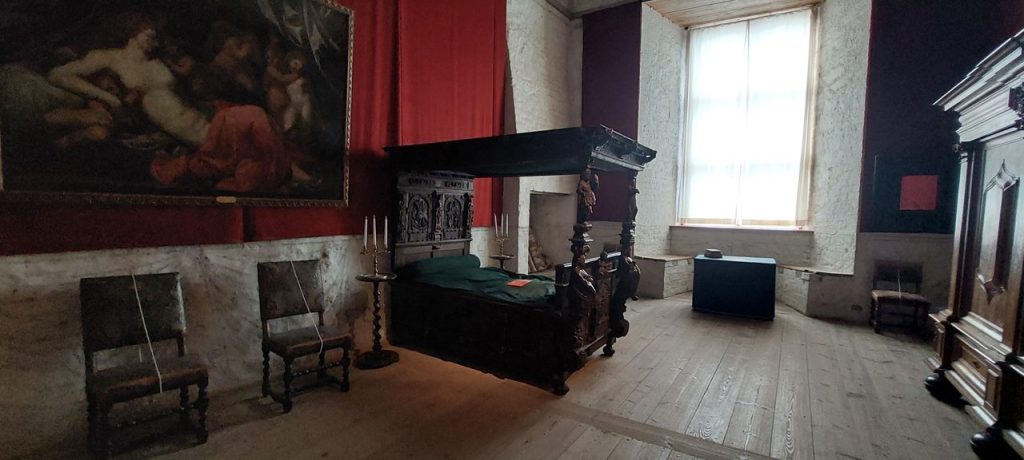
They found Cecilia and Johan in a stage of scantily clad clothing, which, according to the standards of the time, did not suit them. Johan was described as ”hardly wearing his trousers”.
Gustav is said to have burst into tears when the news reached him. For decades, he had worked to establish his kingship and family as equally worthy as other European regents whose families had a much longer history on the throne. From his perspective, what had just happened was a disaster that risked ultimately lowering Cecilia’s chances of a good marriage.
Cecilia is said to have received a beating and had her hair pulled so hard that she later said she thought it would come off her head. Katarina also got an earful because she had failed to supervise her sister.
But he was most furious with Erik, not primarily because Cecilia was found more or less undressed with a man, but because Erik didn’t have the sense to put a lid on it.
Instead of handling the crisis as discreetly as possible, he alerted everyone who could be alerted and interrogated both guards and guests. The rumour immediately gained wings and flew to castles and huts in Sweden and mainland Europe. In the beerhouses, they quickly began singing songs mocking the king’s daughter.
Erik’s clumsy handling of the situation caused Gustav to express his dissatisfaction in a letter to Erik:
” You have pursued this cause to the utmost, not as a brother against his own flesh and blood, but as the supreme enemy. We fear that as long as you follow the advice and encouragement of your own mind, your servants and such of your young company, not only in this paragraph but also for many adventures, both you and all of us Swedes will once wash our heads in our own blood. God better that at some point we should be fathers to such children”.
Before the scandal, Cecilia had been betrothed to Count George Johan av Valdentz, an engagement that immediately came to nothing.
To mitigate the scandal, and probably also because she was simply in love, she expressed her wish to marry Prince Johan, who, after the fateful night, spent six months in prison custody at Örbyhus. He wasn’t interested, though; it might be easy to think he already got what he wanted. But the fact is that Johan never married at all. Maybe it was true, the rumour that Gustav had him castrated.
Cecilia Vasa did well and married Margrave Kristoffer II of Baden-Rodemachen five years later. Regarding adventure and scandal, the Vadstena Rumble was just the beginning.
But all this chaos and disappointment in his children took a toll on her father, and during the spring, his health steadily deteriorated. Just over seven months after the ”rumble”, Gustav Vasa was dead.
Sources:
Cecilia Vasa – The National Archive
Vasarna i Vadstena (The Vasas in Vadstena) – Eva Mattson
Cecilia Vasa – Georg Landberg, Swedish Biographical Archive
Images:
The Royal Castle Tre Kronor – Govert Camphuysen, 1661/Creative Commons
Margareta Leijonhuvud – Johan Baptista van Uther/Creative Commons
Woman formerly believed på be Cecilia Vasa – painter unknown/Creative Commons
Vadstena, castle and bedchamber – blog owner

 Scandinavian History
Lämna en kommentar