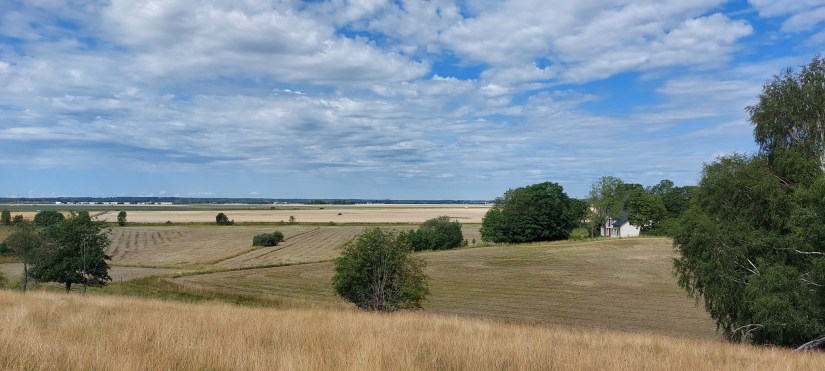
The entire landscape of Stone Age Uppsala was mostly underwater, and during the Bronze Age, Old Uppsala, in particular, consisted of two islands. Only during the Early Iron Age did the region begin to be populated to any great extent by people engaged in agriculture and livestock keeping.
During the 5th and 6th centuries, the large burial mounds, the King’s Mounds, began to be built, which may be the first thing you think about. Over the centuries, both Odin and Frey had been assumed to lie in two of Old Uppsala’s burial mounds, as well as the mythological kings Aún, Adils and Egil belonging to the Ynglinga family, which, according to Snorre Sturlasson’s Ynglingasaga ruled over ancient Uppsala from before the birth of Christ and into the 6th century. Some consider their existence to be confirmed by their mention in the English epic Beowulf, which takes place in what is today Sweden and Denmark.
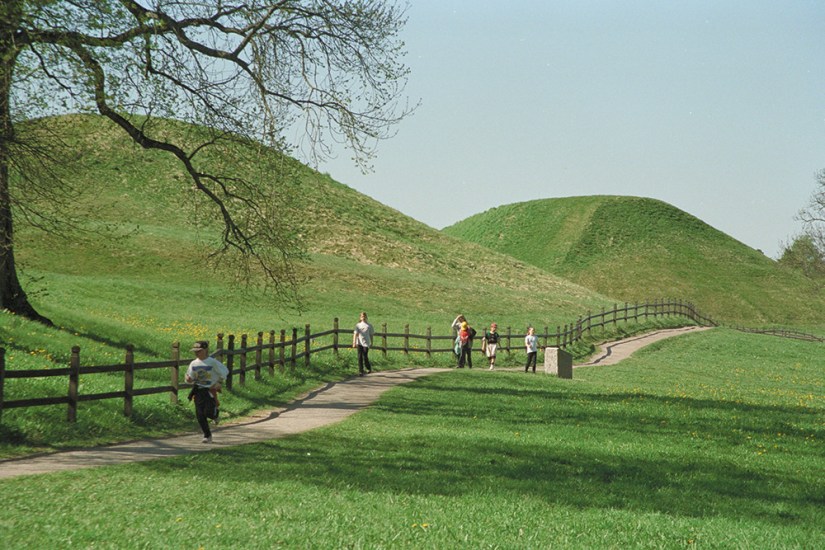
During the middle of the 19th century, two of them were investigated: Eastern mound and Western mound.
The eastern mound, which is the oldest, was investigated in 1846–47 and is considered to have been constructed between 560 and 600 AD. Here, the remains of two individuals were found, believed to be a boy between 10 and 14 years old and an adult woman, possibly a mother and son.
The western mound was excavated in 1847, and initially, it was believed that two individuals, a man and a woman, rested here as well. When osteologists analyzed the bone remains that had not been returned to the burial mound more than 100 years later, in 1999, they could not find that they were the remains of more than one person.
Since it is unlikely that all the bone remains after the second person had been buried again, it was concluded that a mistake was made during the excavation in the 19th century and that there was never more than one person in the West Grave. The remains of bones could not be gendered, but based on the remains of grave goods that were found, it was concluded that a man was buried there. Whoever he was, he was probably buried sometime between 575 and 625 AD.
Nevertheless, it was possible to determine that not just any people were laid to rest in the graves. Among the fragments found were bones from horses, dogs, and birds of prey, which were probably trained for hunting. The dog had been a companion in the life one had left and would remain so in the next, and the horse was both a status symbol and a means of transport.
But fragments of ivory game pieces, glass drinking cups, red garnets believed to come from Sri Lanka, and cameos in gold until today’s Istanbul were also found in the graves. Even if only in fragments, the findings showed that it was not just anyone who was placed here but people with power, influence, and knowledge of the world outside their own patch of land in Uppland.
Whether or not the previously mentioned mythological kings Aún, Adils and Egil existed, this place was a centre of power from the 6th century AD and for several centuries beyond; there is no doubt about this.
Around the royal mounds are also burial grounds, which are believed to have originally consisted of around 2,000 graves. On a map from 1669, you can see close to 700 graves. Today, around 300 remain; the rest have disappeared due to land use.
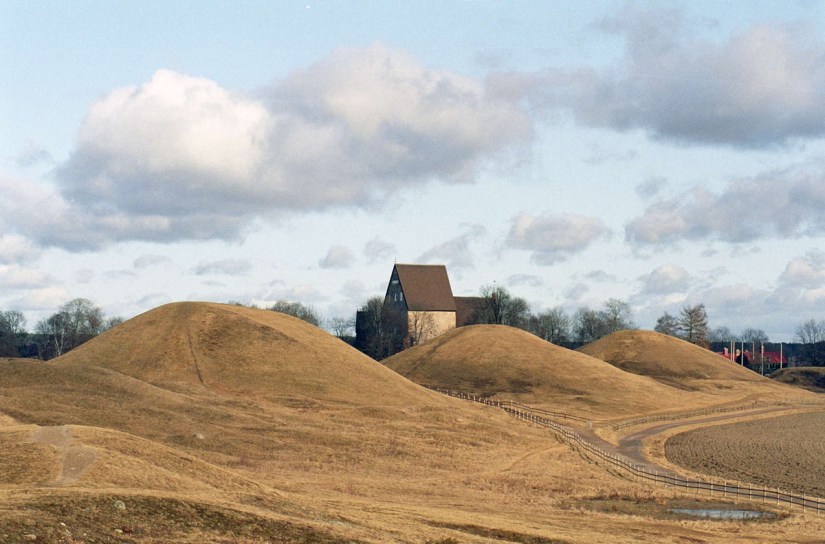
In the current ancient area, there are two man-made plateaus. Archaeological excavations have revealed that at least one plateau was the site of a huge royal building, the size of which is estimated at 200 square meters, erected sometime in the 6th century.
The building had several entrances, with the largest facing north. Where this is estimated to have been, a quantity of more miniature bronze paraphernalia has been found, which makes one think that the northern gate must have been as large as a church gate, decorated partly with small bronze objects, partly with larger fittings in the metal. Those who entered the king’s hall will have been met by large burning fires in the hall, which lit up the supporting pillars and walls, which were all decorated with gold.
The building’s artificial height also meant that not only did one have a mile-long view of the surrounding landscape, but the royal hall was also visible from afar to those who approached. The fact that it was whitewashed is believed to have made it almost glow in the sunlight.
When the building was erected, the area was already populated. Traces of people and settlements from the 5th century have been found in the area, but it was during the 5th and 6th centuries that Gamla Uppsala developed into a power base.
Whoever sat on the throne was not only the king of the Swedes but also the leader of the religious cult, although there were smaller, local leaders with the same function who ultimately obeyed the supreme king.
In the 1070s, Adam wrote about how the Swedes, in a temple wholly decorated with gold, worshipped the three gods Odin, Thor and Frey, who were depicted in the temple, to which sacrifices, according to Adam of Bremen, were brought forward by priests dedicated to each of the three gods. He told in his writing that if illness or famine threatened, sacrifices were made to Thor; in the event of an ongoing or imminent war, it was Odin who was turned to, and in times of weddings, it was the fertility god Frej who was paid attention to.
”The sacrificial rite is obtained in the following way: of every living creature of the male sex, nine are sacrificed, with whose blood the gods are usually appeased. The bodies are hung in a grove near the temple. This grove is held so sacred by the pagans that each tree is considered to have a divine power as a result of the death and decay of the sacrificed bodies. There are also dogs and horses hanging there along with people, and one of the Christians has told me that he has seen seventy-two bodies hanging there one by one. Moreover, as is usual at such sacrificial festivals, various songs are sung, which are indecent and therefore best to be kept quiet.”
Adam of Bremen also told that every ninth year, there was a big blot—a sacrificial feast—in which all Swedes had to participate.
However, one must bear in mind that Adam was marked by his own time, nearly 400 years after the period he described, and many today see his rendering of nakedness as coloured by the fact that he was a Christian.
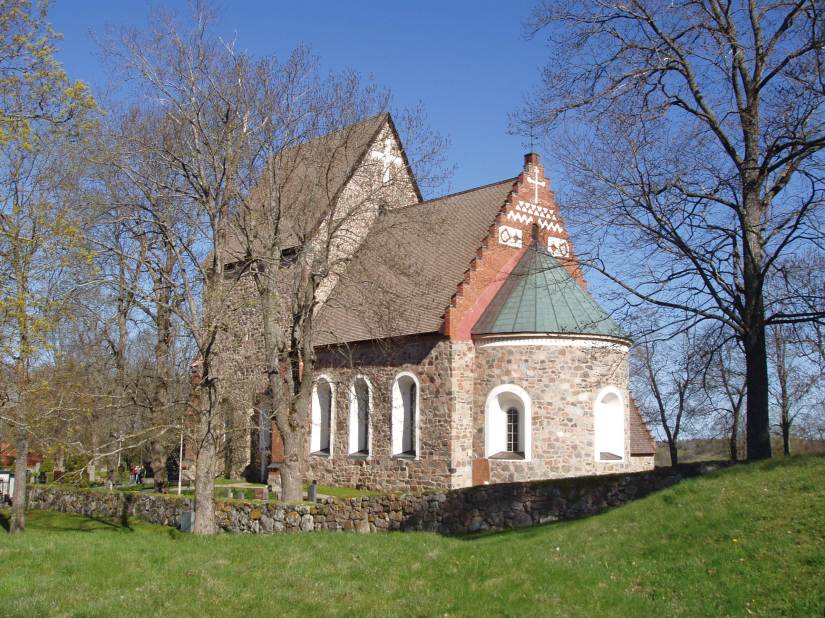
However, archaeologists believe that the temple, of which no remains have been found, may be under the foundation of the church built in the 12th century. When the site was investigated with ground radar, only traces of two older churches were found. No actual excavations have been carried out in or around the church.
Sources:
Uppsala högars datering och några konsekvenser av en omdatering till tidiga Vendeltiden – John Ljungkvist/Fornvännen
Gamla Uppsala: från forntid till nutid – Tore Littmark
Viking Dynasties – The Royal Families of Lejre and Uppsala Between Archaeology and Text – Red. Tom Christensen, John Ljungkvist & Neil Price
Uppsala högar I nytt ljus – Maja Hagerman/Populär Historia

 Scandinavian History
Lämna en kommentar