

The numbers that are found after, or in the middle of, king names can be confusing. For example, Erik XIV was not preceded by thirteen other Eriks. Instead, each of his numbers is a way of trying to show a connection back, and some so-called fairy tale kings were included.
The first king for whom we can say with certainty that there is historical evidence for his existence was also called Erik, as if by chance. Erik Björnsson, or as he became known: Erik the Victorious (Erik Segersäll). This text will be about him.
Although there is historical evidence for Erik, his background is somewhat shrouded in mystery. His surname, Björnsson, means that there are theories that he may have been the son of Björn Eriksson, ”king” of Östergötland. Regarding Björn, the historical sources are too few to confirm his life. He is thus relegated to the group of kings who are mentioned in the saga material, but who, to the extent that they lived, did so far too early for there to be any reliable sources, the previously mentioned saga kings.
Erik, on the other hand, is documented by Adam of Bremen, a German theologian and historian who, in his book on the history of the archdiocese of Hamburg, provides much information about the Scandinavian countries.
These Icelandic sagas should not be confused with Hansel and Gretel-type sagas, and by the Danish historian Saxo Grammaticus. The exact date of Erik’s birth is not known, but one estimate places his birth around 945, possibly in Old Uppsala.
He is said to have begun his reign around 970, and according to the Icelandic Flatöboken, he initially ruled together with his younger brother Olof. However, Olof is said to have died young, and Erik continued to rule alone. The kingdom he ruled over may have included Västergötland, Östergötland and Svealand.
During Erik’s first decade as king, the trading post of Birka was abandoned and burned for unclear reasons, and a new centre for trade became necessary. On Erik’s orders, the city of Sigtuna is said to have been built in the 970s and completed around 980. This makes Sigtuna, Sweden’s oldest city, a statement that is usually met with ”but what about Lund?”, but then one should remember that Lund was not a Swedish city at all during its first 600 years.
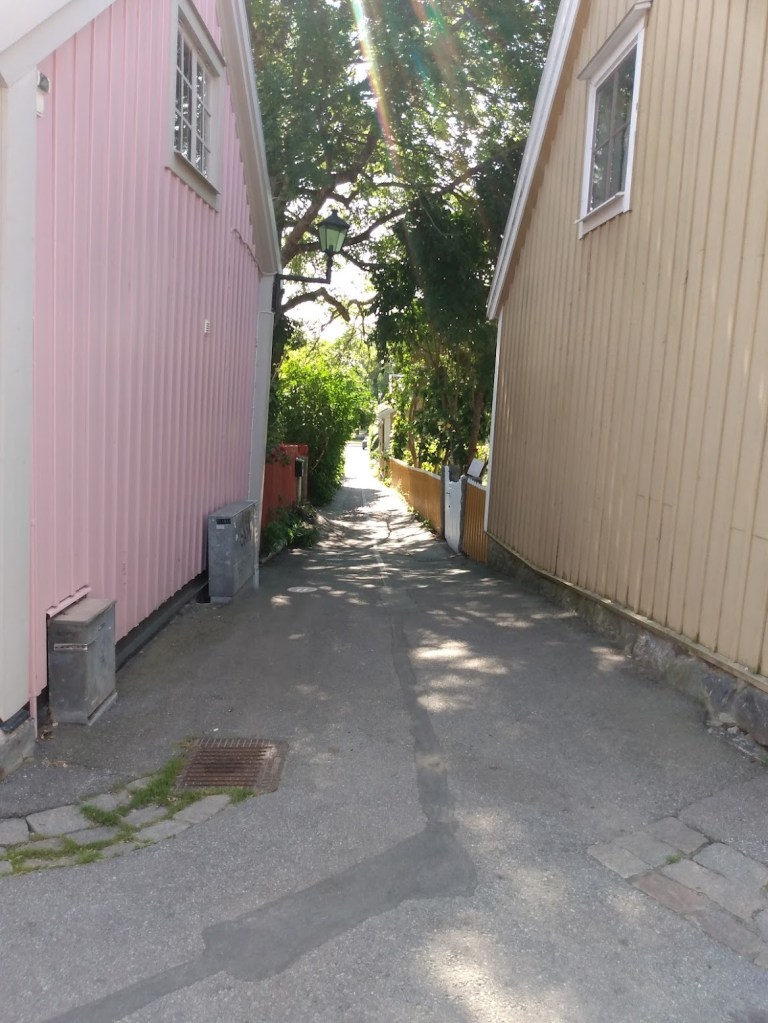
Erik’s Sigtuna was, and is, unique in many ways. First, it was the first city, by the standards of the time, that was actually planned, and the street network that the city has today was the same as it was in Erik’s time. Sigtuna’s location was also carefully planned; the town was built where shipping routes met, which gave it an essential position as a trading city. As the only city that existed in Sweden for a period, Sigtuna became an essential place for both royal power and trade. Under Olof Skötkonung, Erik’s son, it also became the place where Sweden’s first coins were minted.
A decade or so after Sigtuna was founded, Skara would also emerge, but it took about a century before Skara began to be mentioned as an important place.
But all was not peace, joy and a growing kingdom. Some reports claim that Erik’s brother Olof left behind his son Styrbjörn, who eventually came to claim the throne. Erik, for his part, is said to have been uninterested in either sharing power with Styrbjörn or handing over the throne to him; instead, he gave him fully equipped ships, and Styrbjörn is said to have set sail for Denmark.
After a while, he is said to have become the chieftain of the Jomsvikings, a Viking brotherhood that had its stronghold in Jomsborg, a fortress located on the island of Wolin at the mouth of the Oder. In Gesta Danorum, written by Saxo Grammaticus about the history of the Danes, Harald Bluetooth is said to have given the fortress to Styrbjörn, who eventually bore the name Styrbjörn Starke, together with an army which he used to terrorise those who travelled across the sea.
However, Styrbjörn was by no means satisfied with his lot. About ten years after Erik became king, Styrbjörn decided that enough was enough. He went to Denmark and is said to have ravaged the country with his forces until Harald Bluetooth made an agreement with him, appointed him Earl, and let him marry his daughter, Tyra. With Harald’s support, Styrbjörn went on a campaign against the uncle whose heir he considered he should at least be. His forces consisted of the other Jomsvikings.

According to the sagas, he is said to have felt that he had success on his side after Odin appeared to him and said that victory in a possible battle was his. When Erik learned of the impending attack, he is said to have been in what we today call Old Uppsala. He blocked the waterways towards Uppsala, and Styrbjörn and his forces were forced to make their way north along the Fyrisån River on foot.
They are said to have first met, Erik, Styrbjörn and their respective armies, on a field, Fyrisvallen, along the river, where the first clash took place. According to the Icelandic Flatöboken, Erik had arranged a violent welcome for the enemy army. He had been advised by Torgny the lawman to yoke all the horses and oxen that could be spared, and to attach spears and protruding points to the yokes. The next step was to have slaves and ”criminals” drive the animals against the attacking forces.
This tactic is said to have defeated many of Styrbjörn’s men, but the result was that the two armies became more equal, not that it gave Erik an advantage. This first day of battle was a draw.
To ensure that he would be the one who ultimately emerged victorious, both Erik and Styrbjörn are said to have engaged in offerings after the battle to appease the gods. Styrbjörn is said to have turned to Thor, who is said to have appeared to him and apparently was not at all pleased with either Styrbjörn or the circumstances. According to the Flatöboken, Thor is said to have recited a poem:
”Styrbjörn, who destroys the unity of the people and disturbs the peace, he does not let me be in peace – I am angry with the ruler of steel. The seed sown here will later cause the victorious army to bind its wounds. Red are the shields of the celebrated men.”
A poem that frankly sounds more threatening than promising.
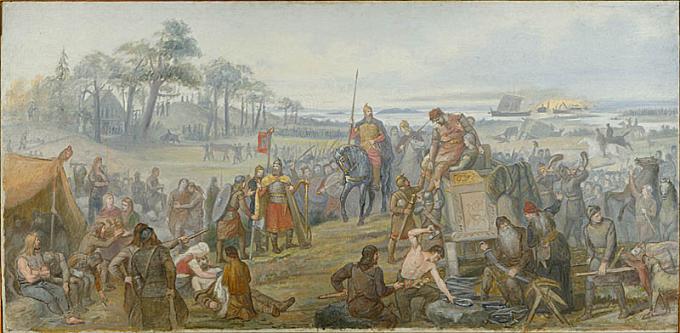
Erik, for his part, visited the temple in Old Uppsala and made a sacrifice to Odin, and is also said to have promised to give himself to Odin in ten years. He is then said to have met a large man who partially hid his face, due to the lack of an eye, one can assume, with the help of a hood pulled over his head. The man is said to have given him a staff and urged him to throw it at the enemy army while uttering the words ”Odin a ydir alla” – Odin owns all. According to Old Norse mythology, Odin and Freya divided the fallen warriors on the battlefield, but this time, he apparently wanted them all for himself. Odin was also considered to be present in battles, and possibly so this time as well.
When Erik threw his staff, it transformed into a spear in the air. What can be said with certainty is that Erik defeated Styrbjörn’s army and that Styrbjörn himself died in the battle. It is assumed that this happened with the help of more conventional, armed combat. But while you can pick out grains of pure fact from the Icelandic sagas, there are times when they, to put it mildly, embroider the events a little. According to the Flatöboken, the staff is not only said to have transformed into a sword when Erik threw it, but it is also said to have blinded the enemy army and then drowned them in a landslide. According to legend, Snake’s Head Fritillary started growing on the battle field: white for Erik’s troups and red for Styrbjörn’s.

In addition to the written sources describing the Battle of Fyrisvallarna, the event is also considered confirmed by several runestones erected in Scania that mention a battle at Uppsala, and that Toke Gormsson did not flee the battle but died with weapons in hand. Toke Gormsson was the leader of Styrbjörn Starke’s Danish allies, and unlike several of the Danish combatants, he did not flee when it became apparent what the outcome of the battle would be.
Erik seems to have been on good terms with Harald Bluetooth, at least periodically, but his relationship with Harald’s son Sven Forkbeard was different.
After the victory at the Battle of Fyrisvallarna, Erik went with his army to Denmark and expelled Sven from the country, and then placed himself on the Danish throne. Since Harald Bluetooth had decided entirely that the Danes were a Christian people, Erik had himself baptised into the new religion.
When he then returned to Sweden, however, he is said to have repented and returned to the old gods. Erik’s rule over Denmark has later been disputed among recent historians, but is mentioned by both Adam of Bremen and Saxo Grammaticus. Adam of Bremen also states that he was told this by Sven Estridsen, grandson of Sven Forkbeard, through his daughter Estrid, and later regent of Denmark, who was probably knowledgeable about what his grandfather’s reign had been like. As a curiosity, it can be mentioned that Sven Estridsen had been raised at the court of the Swedish king Anund Jakob, grandson of none other than Erik Segersäll.
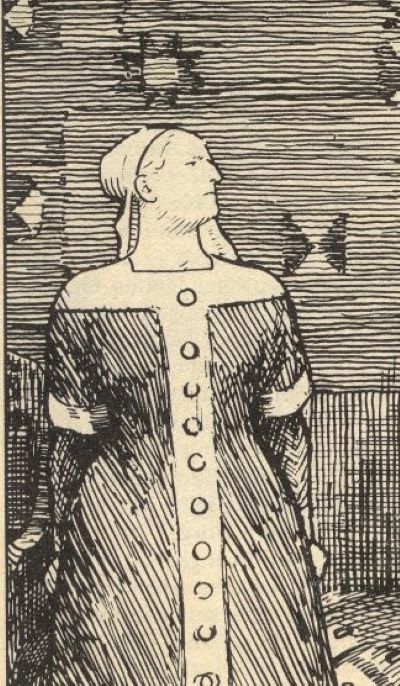
We know that Olof Skötkonung, Sweden’s first Christian king, was the son of Erik. However, there is greater uncertainty about who Erik’s queen was. She is mentioned in the sagas as Sigrid The Haughty (Sigrid Storråda), but who is hiding behind that name is not entirely clear. Some believe that she was the daughter of a powerful man from Västernamed Skoglar-Toste. Still others think that she was the daughter of the Wendish duke Burislav. The problem here is that it is not entirely certain that Burislav himself even existed. A third theory is that Erik was not married to any Sigrid Storråda at all, but to a Polish princess named Swiatoslawa, who in the sources is given the Swedish name Gunhild.
However, if we now believe that there was a Sigrid the Haugthy, then after Erik’s death, she is said to have remarried the Danish king Sven Forkbeard. Thus, she became not only the grandmother of Sven Estridsen but also the grandmother of Anund Jakob.
Erik Segersäll, who received his new surname after the victory at Fyrisvallarna, died ”sotdöden”, which in ancient times was an expression for dying in a non-violent way, that is, as a result of illness, either in the autumn of 994 or the winter of 995. In fact, his death occurred roughly ten years after he promised Odin that he would give him his life ten years later.
Sources:
Erik Segersäll – Srure Bohlin/Svenskt Biografiskt Lexikon (Swedish biographical Lexicon)
Spåren av Kungens Män – Maja Hagerman (Traces of the King’s men)
Vikingarnas största slag/Slaget vid Fyrssvallarna – Kim Hjadar (Greatest Battles of the Vikings)
Sveriges regenter från forntid till nutid – Lars O Lagerqvist (Swedish regents from ancient to modern times)

 Scandinavian History
Lämna en kommentar