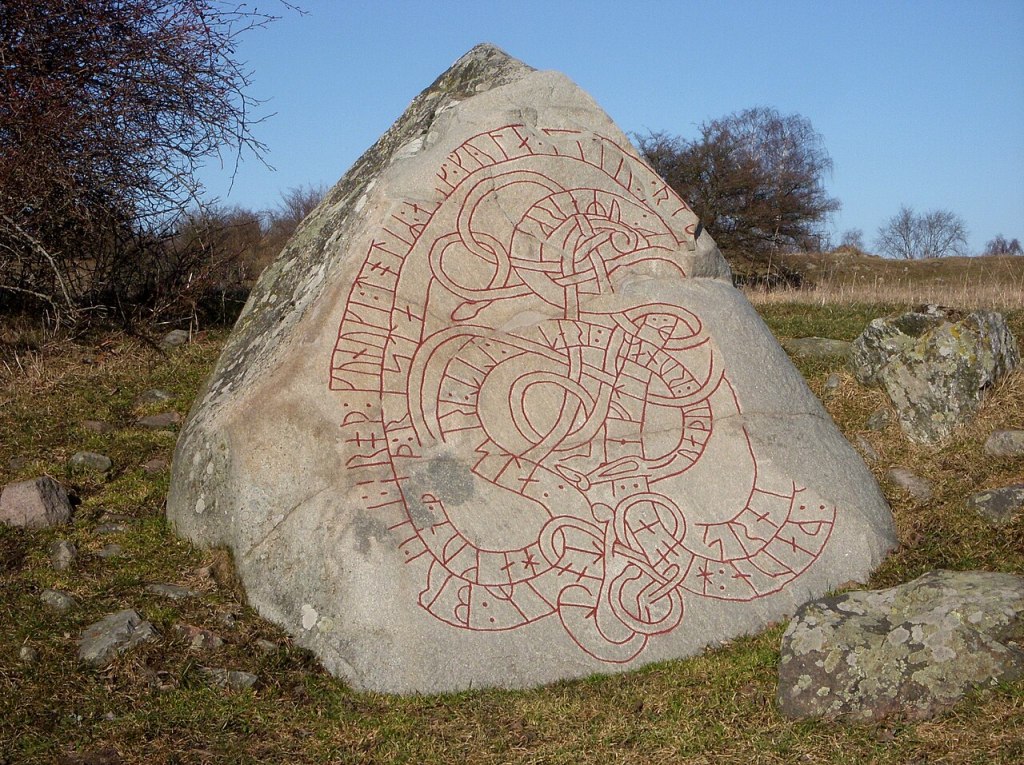
Runestones rightfully fascinate many. They are voices from a bygone era that often tells of a loss in the sense that they have mostly been raised by a parent or other relative of someone who no longer exists.
There are runestones in all Scandinavian countries, with the vast majority in Sweden and a marked concentration in the Mälardalen. From Brösarp in Skåne to Östersund in the north, one finds 2,500 carved stones that, mostly briefly and sometimes incomprehensible, tell about the world as it was around 1,000 years ago.
There are around 300 stones in Denmark, and in Norway, 150. It should be emphasized here that it is not a matter of found objects with runes because then the numbers look somewhat different, since not least in Norway, a large number of objects with runes have been found in front of all wooden objects from the Middle Ages
No traditional rune stones have been found in Finland, which is not included in Scandinavia but is obviously one of the Nordic countries.

As a rule, runestones are thought of as relics from the Viking Age, and that is true for most of them, but it is not true for all. In Norway, the Hogganvik stone is found in Lindesnes municipality, Agder county. In 2009, it was also found and tentatively dated to 350 – 500 AD.

It is carved with the older futhark, or Old Norse runes as they have also come to be known. This rune line consisted of 24 runes and was used between the year 0 and the 7th century when it was replaced with the younger futhark, which consists of 16 runes.
The Hogganvik Stone has four lines with 62 runes, making it one of the longest Old Norse runic inscriptions. It is read from right to left.
When further archaeological investigations were carried out in 2010, it was established that the stone had once been raised by a grave. But, due to house construction over the years, the grave was obliterated.
The Hogganvik stone had a text that could be deciphered in some parts: Skelba-þewaʀ’s [”Servants of Shaking”] stone [=(tomb) monument].[Possibly runic part:] aaasrpkf | aarpaa From inside(?) the wheel hub(?) [or: needle(?)]. I [=the runemaker] [is] Naudigastiʀ [=”Emergency guest”]; I, [called] The Wolverine.

No kind of destruction has happened to a migration-era runestone in Sweden: the Krogstastenen (U 1125), which remains in the place it was once erected (not the case with all runestones), in the northwestern part of a burial field in Krogsta, about one kilometre from Tuna church in Uppland. The stone was erected in the 6th century when the migration period passed into what in Sweden is called Vendeltid.
The stone is carved with short rows of runes on both sides, also here with the older futhark, which has proven difficult to interpret. The only thing that can be interpreted with certainty is the word s(t)ainaz on the back of the stone.
The mystery of the text has, of course, attracted various imaginative interpretations, where runologist and professor Sigrud Agrell and religious historian Åke Ohlmarks seemed to be able to decipher the words ”Sven rests here. Do not disturb his resting peace, because terror is born from the number nine”. The number nine had a special meaning in Old Norse mythology, where Odin, among other things, hung in Yggdrasil for nine days to learn precisely the secrets of the runes, and there are nine worlds.
The Norwegian runologist Ottar Grønvik, on the other hand, considered that it says ”Abbot’s (priest’s) stone.” However, the stone was erected many hundreds of years before Christianity reached Svealand, so even if there were cult leaders, these were neither abbots nor priests.
Some interpret the stone as a warning, not so much because of the essentially undeciphered text as because of the figure that shares the stone with the runes. With a face that can almost be described as a skull and hands raised in either a gesture of aversion or worship, he has been staring at visitors for a millennium and a half.
Just like the inscription, the figure is a mystery that may never be solved. Whether the stone was carved by someone who could not decipher the runes himself or whether it is a so-called maple script will attract speculation even in the future.

Of course, it is impossible to describe all of Scandinavia’s nearly 3,000 runestones in one blog post, which is already the longest here.
But some will join, and we start with what can be called the celebrities of the rune stones:
The Rökstenen (Ö 136), which stands in the parish of Rök in Östergötland, is believed to be from the first half of the 8th century. The runes on the stone differ from the rune stones of the 11th century and are written with several different types of runes: the older one with 24 runes, the younger one with 16 runes, ice runes – a kind of secret rune – and twig runes. With its 760 runes, the stone is considered the longest runic inscription in the world and is seen by some as the oldest literary work.

The stone is carved on all four sides, and while it is not yet fully interpreted, it is believed to be the story of various kings, including ”Tjodrik,” which has been interpreted as referring to Theoderic the Great, king of the Ostrogoths and for a period of time Italy during the 5th century.
The stone has six slanted crosses, three on the ”back” of the stone and three on its top, which have been interpreted as secret runes.
In Denmark, the Jelling stones are seen as the leading celebrities of the Danish rune stones. King Gorm the Old erected the smaller of the two stones in memory of his wife, Tyra Danebot, in about 955. This is the oldest Danish source where Denmark is mentioned.

The larger stone, in turn, was erected by Harald Bluetooth in memory of his father, Gorm the Old. Harald was the king who Christianized Denmark in the 9th century, and the stone draws attention to this on one of the three carved sides, where you can see the crucified Jesus.


The Vang stone in Oppland County is Norway’s most famous runestone, not mainly because of its runic inscription but also because of its imagery
Norway can also boast of what is believed to be the oldest runestone in the world; in 2021, this stone was found at a burial ground in Svingerud in Hole municipality outside Oslo. The stone is now dated to the period between 0 and 250 AD, meaning it is around 2,000 years old. The stone, named the Svingerud stone, also has a B rune that is not equivalent to any currently known rune stone.

.
The rune stones were mainly erected during the period that has come to be known as the Viking Age, which may bring to mind ancient asatro, or ancient custom as it is called. Still, the fact is that in Sweden, 58 per cent of roughly 2,000 rune stones are marked with crosses, which suggests that those who raised the stones were Christians. This, of course, applies to the stones that were erected during the 11th century.

Having said that, there are, of course, also stones connected to the old gods. One of these is located in the Altuna cemetery and is thus called the Altuna stone (U 1161). The stone is erected in memory of a father and a brother who died in a fire.
Translated into contemporary English, the text reads, ”Vifast, Folkad, kuÞar leto raise the stone after his father Holmfast (and after his brother) Arnfast.” Father and son were both burned to death. And Balle and Frösten, Life’s companions, (carved).”
Here, you can see the god Thor on his fishing trip. During the fight with the monster that held the world together, he hooked the Midgard Serpent and trampled through the bottom of the boat. It would take 200 years before Snorre Sturlason wrote down the same story about how long the oral tradition was alive.
The stone also shows what could be Odin with his ravens.
On Ramunds mountain in Södermanland and at Göksbo in Uppland, you can also find stones where Sigurd Fafnesbane (the dragon slayer), who also appears in Old Norse mythology, is depicted.

In Sweden, there are also what can be called ”theme stones,” which, even if they are scattered over an area, tell the same story. These include the Ingvar stones, the England stones and the Greek stones.

The Ingvar stones tell about the disastrous Viking voyage to the east under the leadership of Ingvar den Vittfarne, who is said to have been the great-grandson of Erik Segersäll, Sweden’s first historically confirmed king and founder of Sigtuna.

The journey supposedly took place between 1036 and 1041, and its disaster can be deduced from the fact that none of the 25 runestones, mainly in the Mälardal region, that describe it mention that anyone would have survived. According to Ingvar den Vittfarnes Saga, only one ship out of about 30 should have returned to Sweden.
The most famous of the Ingvarsstenarna is the Gripsholmsstenen, which laconically states that those participating in the journey died in Särkland (the regions around the Caspian Sea; present-day Armenia, Azerbaijan, Georgia, Turkey, Iran, Iraq as well as Russian areas around the lower Don and Volga);
Tola had the stone erected for her son Harald, Ingvar’s brother
They went manfully far for gold
and to the east, the eagle gave food.
They died in Särkland.
During one period, the Gripsholms stone was used as an entrance stone at Gripsholm castle.

The English stones, on the other hand, are spread over a larger area than the Ingvarsstenarna but are nevertheless found predominantly in Sweden.


Here, it is not surprising that Viking voyages to England are described, and there are 30 in Sweden, one in Norway, and a Swedish stone in German Schleswig, which was once Danish and housed the Viking-era trading post Hedeby.
One of England’s stones is the Grinda stone (Sö 166) in Södermanland, which, translated into modern Swedish, tells us that:
”Grytgard, Ändride, the sons, did (the care) after their dashing father. Gudver was westward in England, shifted the (Dane) debt, haunted Saxony (now Germany), the town of the population.”


The last group of these stones are the Greece stones, which, like the previously mentioned ones, tell about travels, in this case to Greece, which during the Viking Age referred to the entire Byzantine Empire. Again, these are found in Sweden, with a concentration in the Mälardalen and Gotland. Many of those whom the stones are erected in memory of were part of the Varangian guard, the elite force that protected the Byzantine emperor. One of the Greece stones is today in the Ashmolean Museum in Oxford, due to James II asking Charles XI for two runestones for the museum in 1687.


I will round off this very long stone by saying that some stones were painted when they were new. This is known by the fact that the person who carved the stone mentioned it and that preserved paint fragments were found in some cases, as in the stone fragment from Köping’s church on Öland, where the colour still remains, if somewhat faded. Not improbably, the brown part was once black and the orange runic loop red.
Sources:
Experten om rekordgamla runstenen: ”Forskningen får omvärderas” – Riksantikvarieämbetet.
Rune stones in churches, a link between heathen tradition and Christian faith? – Lars Våge Rickard Bindberg, uppsats i historisk arkeologi, Lunds universitet.
Runstenar i Uppsala län berättar – Marit Åhlén.
Runes in Sweden – Sven B. F. Jansson
Language, name, images and colour – Riksantikvarieämbetet
Regarding painted rune stones; question also asked and anwared by archaeologists in the group ”Archaeology in Sweden”.
Images:
Rök stone – Bengt Olof Åradsson
Jellinge stone – Jürgen Howaldt
Vang stone – John Erling Blad
Altuna stone – Bengt A. Lundberg/Riksantikvarieämbetet
Gripsholm stone – Blog owner
Greklandsstenen – Ethan Doyle White
Painted stone fragment, Köpings kyrka, Öland – Bengt A. Lundberg/Riksantikvarieämbetet


Lämna en kommentar