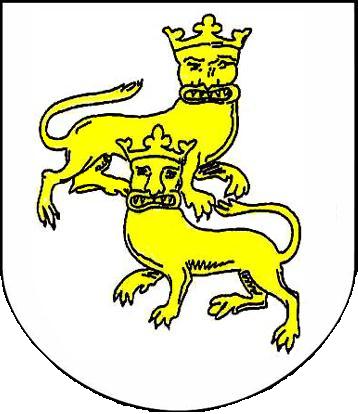
It aired a few years ago. Still, many likely remember ”Game of Thrones”—George R.R. Martin’s story about various noble houses vying for power and the throne in, among other places, the fictional realm of Westeros. One of Martin’s sources of inspiration is said to have been the long-running dynastic conflict in 15th-century England known to history as the Wars of the Roses.
Yet we have had our own ”Game of Thrones” on several occasions. The first thing that comes to mind for many is perhaps the wars and conflicts surrounding the Kalmar Union—primarily between Sweden and Denmark. However, we shall stay within the country’s borders and examine a different struggle for the crown: the one between the House of Eric and the House of Sverker.
Chronologically, we find ourselves in the 12th century, and we begin with a brief—well, relatively brief—introduction to each of the two houses.
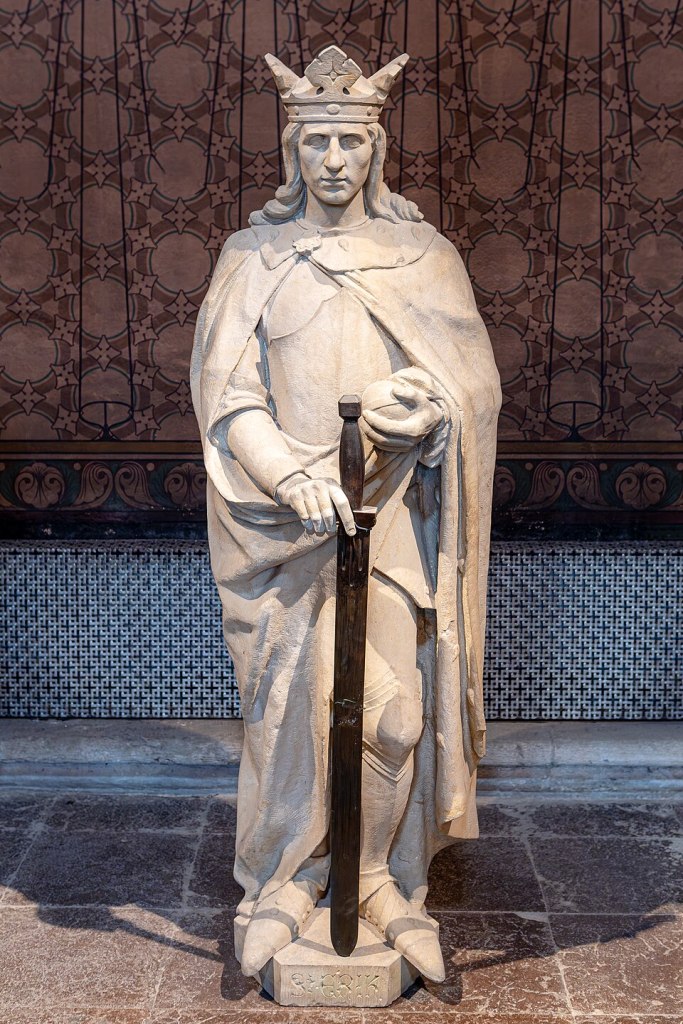
The House of Eric begins with the man who was never canonised by the Pope—perhaps the remark about the Pope having no intention of canonising a drunkard referred to him, or perhaps to someone else—but who nevertheless became Sweden’s patron saint: Eric the Holy, or Erik Jedvardsson, as his actual name was.
The House of Eric had its base and roots in Västergötland and could therefore count on support from Svealand and Norway in the conflicts that lay ahead. Unlike the House of Sverker, the House of Eric sought the greatest possible autonomy vis-à-vis the Pope in Rome and wished to appoint the country’s bishops themselves. Rome did not yet wield significant influence over Sweden during the 12th and early 13th centuries—especially compared with neighbouring Denmark, which had been part of the European Catholic community since the 10th century. This stance did not win the Church’s favour; consequently, the Church usually sided with the House of Sverker in these conflicts.
The House of Sverker, by contrast, was more internationally oriented and thus generally enjoyed the Church’s support in the struggle against the House of Eric.
It is worth noting that Eric the Holy reigned as King of Sweden—or at least over the territory that constituted the kingdom at the time—for only about six years before being murdered while attending a church service in Uppsala. Here, we already see the kind of violent twists that characterise George R.R. Martin’s saga: Eric was killed by Magnus Henriksson, a Danish nobleman and the great-grandson of the Swedish King Inge the Elder. As an interesting aside, this also made him a relative of Eric the Holy’s wife, Kristina, whose maternal grandfather was Inge the Elder.
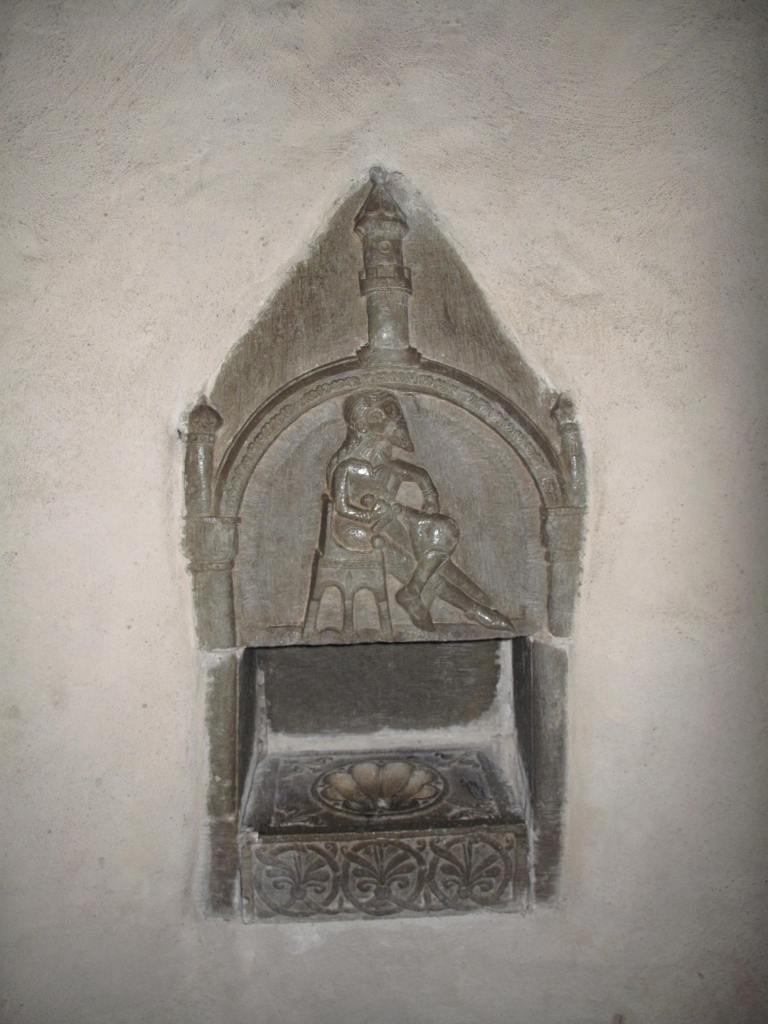
However, Magnus reigned for only about a year before he, too, was murdered. His killer was , the son of King Sverker the Elder—whom Magnus had had assassinated before killing Eric the Holy. Magnus Henriksson met his end in what may well be one of the least documented battles in our history: The Battle of Örebro in 1161. It is so sparsely documented that, had it not been mentioned in the list of kings in the older Västgötalagen (Law of Västergötland) from 1220, we might not have known it took place at all. The battle is also mentioned in the slightly later ”Codex Upsaliensis”—one of three medieval manuscripts of Snorri’s Edda, and therefore also known as the Uppsala Edda.
If it is murder you are looking for in a dynastic fantasy saga, then we already have a few chapters drawn straight from our own history.
After the victory at Örebro, Karl proclaimed himself King of the Swedes and the Geats—which, at the time, was the closest one could get to calling oneself King of Sweden. Although we were still balancing on the edge of paganism—officially Christianised, yet in truth the faith had not yet fully taken root among the common people—Karl’s reign nonetheless helped bind us more closely to the Catholic community of Western Europe: Sweden gained its first archbishop through Karl’s appointment of Stefan, a monk from Alvastra. In the 15th century, claims emerged that he had also founded Vreta Abbey in 1162, though it is more likely that he merely reorganised the institution. What is certain, however, is that his sister Ingegerd served as abbess there between 1164 and 1202. But since this particular detail has little bearing on our Game of Thrones narrative, let us return to Karl himself.
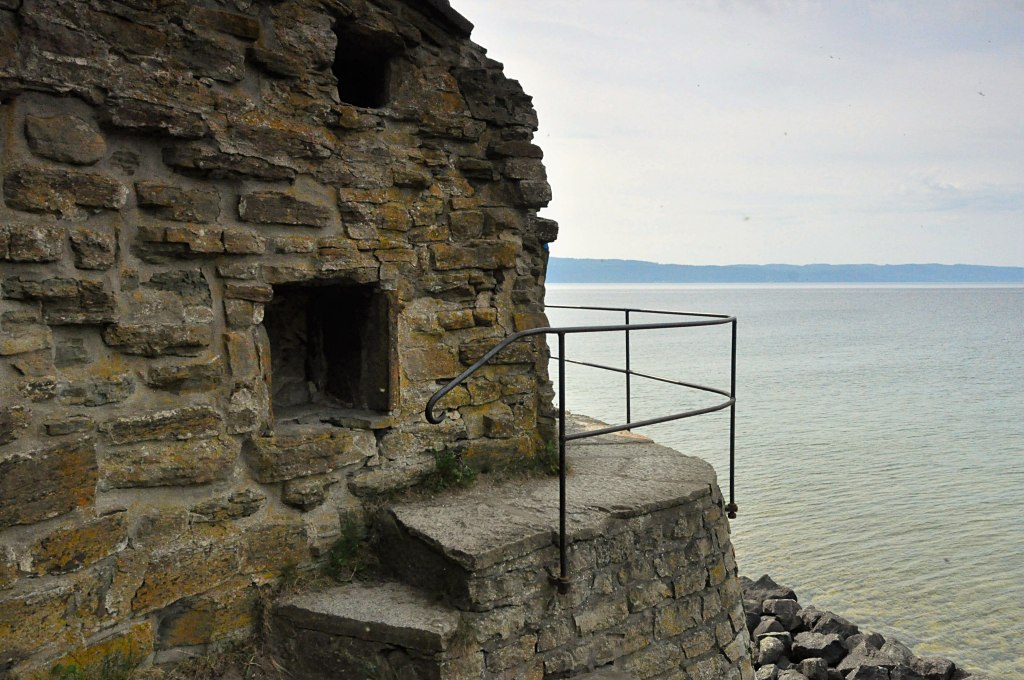
He, too, did not reign for long over ”them all,” for waiting in the wings was the son of Eric the Holy, Knut Eriksson. In the spring of 1167—on April 12, to be precise – Karl was ambushed on the island of Visingsö by Knut and his men while travelling from a mass he had attended to his residence at Näs Castle; he was murdered after a reign of only about six years. For those who delight in trivial coincidences, it is interesting to note that his father, Sverker the Elder, had also been killed while on his way to mass—specifically, the early Christmas morning service. One might wryly reflect that medieval kings perhaps ought to have been more cautious about the routes they took.
This is where it truly begins—even though, given the preceding events, one might have thought it had already started. Yet, while Eric the Holy was the progenitor of the House of Eric, it was not until the time of Knut that the dynasty began to assert itself on the political stage of the twelfth century. Despite his brief reign, Karl had managed to establish a degree of political stability in the realm—stability that was now shattered by yet another shift in power.
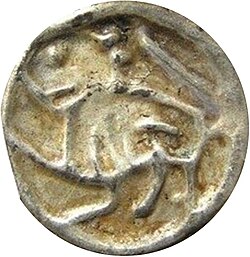
Karl Sverkersson’s son—likely the intended heir to the throne—fled to Denmark to bide his time while feuds raged back home across the sound. Two pretenders to the throne emerged: Burislev and Kol. Both were related to Karl, though the exact nature of that kinship varies by source. Either they were both sons of Sverker the Elder from his marriage to the Polish princess Rikissa—making them, quite simply, half-brothers to Karl Sverkersson—or they were the sons of his brother Johan, which would logically make them his nephews.
In any case, they briefly thwarted Knut Eriksson’s ambitions to become king. For a time—up until the early 1170s—there were three individuals (two of whom, Kol and Burislev, ruled jointly) who believed they were the rightful occupants of the realm’s throne. However, a few years into that decade, the two disappeared from the historical record, leaving only Knut Eriksson. It is reasonable to assume that the son of Eric the Holy simply killed them at some point, though the specific time and place have not been preserved.
For a time, Knut could consider himself securely—or at least relatively undisturbed—seated on the throne; the only member of the House of Sverker capable of challenging him had, as previously mentioned, fled to Denmark. It should also be noted that when Karl Sverkersson was killed in 1167, his son Sverker Karlsson—or Sverker the Younger, as he would come to be known—was little more than a toddler; thus, his flight took place in the arms of his mother, Queen Kristina.
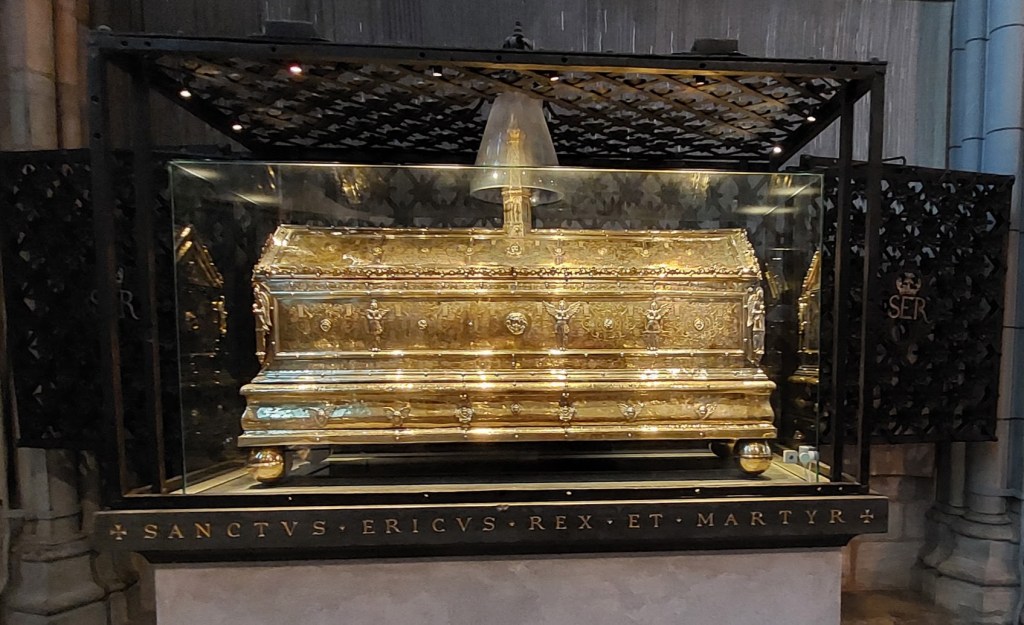
Knut wanted his father canonised as a model for what were essentially monarchical ambitions; he looked to another royal saint—Olav the Holy of Norway—who had attained sainthood and been canonised by the Pope after falling in the Battle of Stiklestad. However, as previously mentioned, the Pope likely took issue with this. I say ”likely” because, as noted, we do not know with absolute certainty whom the Pope was referring to in his indignant letter, in which he stated that he would not tolerate the veneration of someone who had been killed while drunk. As a curious aside, the official account of Eric the Holy’s death states that Magnus Henriksson arrived at the Church in Uppsala while Eric was attending Mass. Everyone was urged to flee, but Eric refused—an act of defiance characteristic of someone not entirely sober? According to legend, he was struck down and killed as he emerged into the churchyard.
What we do know for certain is that the remains preserved in the reliquary at Uppsala Cathedral belong to a man who, at the time of his death, was the same age Erik is said to have been. The skeleton also bears the very injuries he reportedly sustained according to legend. What has not survived the centuries, however, is any record of his blood alcohol level.
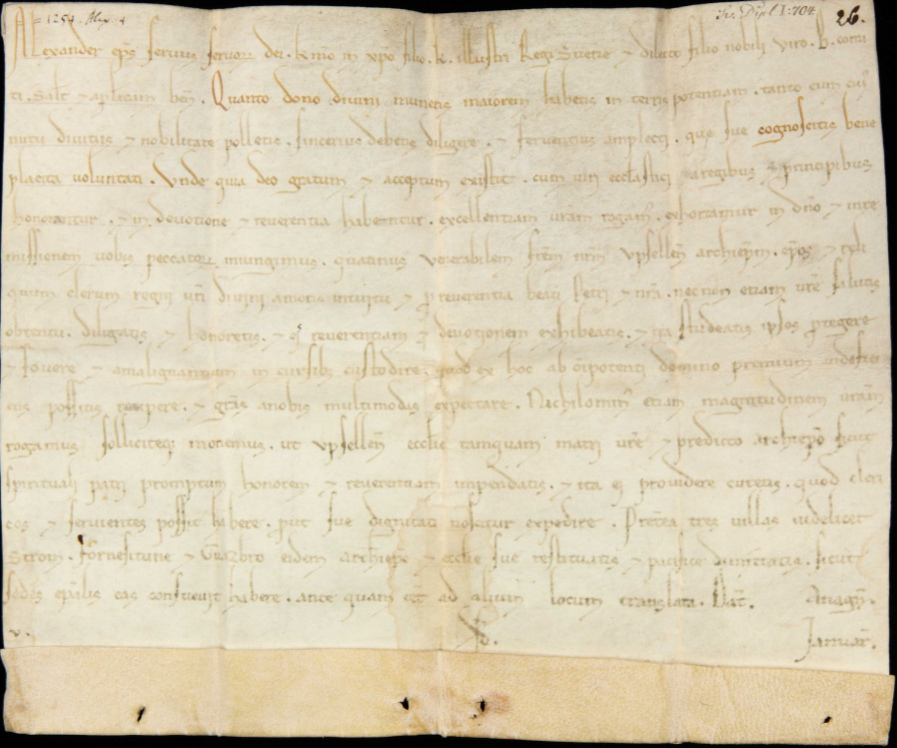
The letter from Alexander III is addressed to a king whose name begins with the letter K. Consequently, we do not know when the letter was sent or who the intended recipient was; it could have been Knut, Kol, or Karl. In addition to refusing to canonise Erik, Alexander also forbade any further veneration of the presumably inebriated monarch. One cannot help but wonder what Alexander would have said had he known that, 866 years after his death, Erik would hold the status of both a national saint and the patron saint of the city of Stockholm. Perhaps he would not have been surprised; the Swedes had a reputation for doing much as they pleased in their dealings with Rome for a couple of centuries.
To be contiued….
Sources
Sveriges Medeltid – Dick Harrison
Svenskt Diplomatariums Huvudkartotek
Den äldre Västgötalagens Kungalängd
Sverker den äldre – Svenskt Biografiskt Lexikon/Roger Axelsson
Erik den Helige – Svenskt Biografiskt Lexikon/Sture Bolin och Bengt Hildebrand
Magnus Henriksson – Svenskt Biografiskt Lexikon/Hans Gillingstam
Knut Eriksson – Svenskt Biografiskt Lexikon/Hans Gillingstam
Sverker den yngre – Svenskt Biografiskt Lexikon/Roger Axelsson


Lämna ett svar